By: Karen Juanita Carrillo, New York Amsterdam News
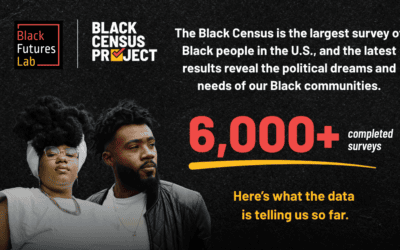
Black communities today face high daily expenses, threats from far-right politicians, and a federal government that is openly working to increase inequality. With the launch of its third Black Census Project, the advocacy group Black Futures Lab wants to document how Black people are handling these issues. For this census, it asks Black people how the country could improve.
For this year’s project, launched on March 30, Black Futures Lab wants to get more Black people across the country to participate than ever before. It builds on two previous censuses, conducted in 2018 and 2022. “We’ve done it now twice,” said project leader Kristin Powell in an interview. “… in 2018, … we reached 30,000 Black people across the country. … in 2022, [we] reached 211,000 Black people. And our goal this time is to reach 300,000.”
Powell acknowledged that “Black people don’t want to share information for all the reasons that we know,” she said. “We’ve been harmed, we’ve been lied to, we’ve been manipulated, and our data has been used against us, right? In 2018, we had that hill to climb, where we’re coming in, asking people … if we can listen to them. But also, we’ve had a lot of promises made, and nothing comes of it, so in 2018, it was about building with Black people and making sure that they understood that this is our data, this is not being sold to people, this is not being used for … some capitalistic gain. This is about what do we want, and how do we push an agenda together around that?” In 2018, the Black Census Project was the impetus for an agenda that prioritized criminal justice reform, healthcare access, living‑wage jobs, voting rights, and environmental justice. In 2022, Black Census respondents emphasized economic issues. “The economy, the economy, and the economy” was the dominant theme, Powell said. “We had a lot more people talking about their pocketbooks, and when they talked about affordability, they were really talking about three things: I can’t afford housing, I can’t afford childcare, I can’t afford healthcare. There was also some talk about student loan debt, but that was centered around a certain demographic — millennials like myself who are kind of drowning in student loan debt. The first three were universal, across all age groups.”
The Black Census Project is not affiliated with the federal census that is conducted every 10 years. In this anonymous survey, the Black Futures Lab is trying to get a reading on the needs of Black people from different regions, age groups, and backgrounds, and to ask their opinions about how they are being governed. Economic inequality has long shaped Black life in the United States, but Powell noted that in recent years, price spikes have been unprecedented. In cities like Valdosta, Ga., she said, rents jumped from $800 to $1,500 in a single year, even though the average income remained under $40,000. “Those kinds of increases are new, and people are feeling them everywhere,” she said.
The 2022 census also showed that Black communities have a mistrust of major institutions such as banks, police departments, and the federal government, yet many Black individuals have conservative views about taxation, corporations, and small businesses because they believe any increase in taxes might affect them personally, Powell said.
Instead of re‑asking questions the organization already feels have been answered, about policing, schools, or economic stress, this year’s survey focuses heavily on imagination. “Our last two surveys assumed we had some semblance of a democracy where elected officials believed they worked for us,” Powell said. “We’re not currently in that system.
“Because of the system that we’re currently in, where we have an escalation of fascist policies, we’re using this next iteration as a little bit of an imagination project to get Black people to envision what a system of government should look like that would work for all of us.”
Participants are invited to describe what a system that truly works for its citizens would look like — and how it might be built. The organization does not publicly release the raw data from its findings, but will share the information in reports, press briefings, community road shows, and an interactive dashboard that it will post on the Black Futures Lab website. A preliminary analysis of the Black Census Project’s findings is expected to be completed by late summer 2026. People of African descent from across the U.S. are urged to take part, including immigrants, the formerly incarcerated, and those whose voices are usually not included in public data collections. Most survey takers will be able to complete it online at https://blackcensusproject.org/, but in-person surveys — the result of door-knocking, community event pop-ups, and partnerships with grassroots organizations — will also take place. The survey is available in at least six languages: English, Spanish, Haitian Creole, Portuguese, Amharic, and Yoruba. For a hard (paper) copy, send a request by email to holla@blackfutures.org.
To read the original article, click HERE.